The November 18 order ties the administrative stay to a future appellate judgment. Do not treat November 20, or the withdrawal of a Supreme Court application, as automatic restoration of TPS or employment authorization.
What changed on November 18
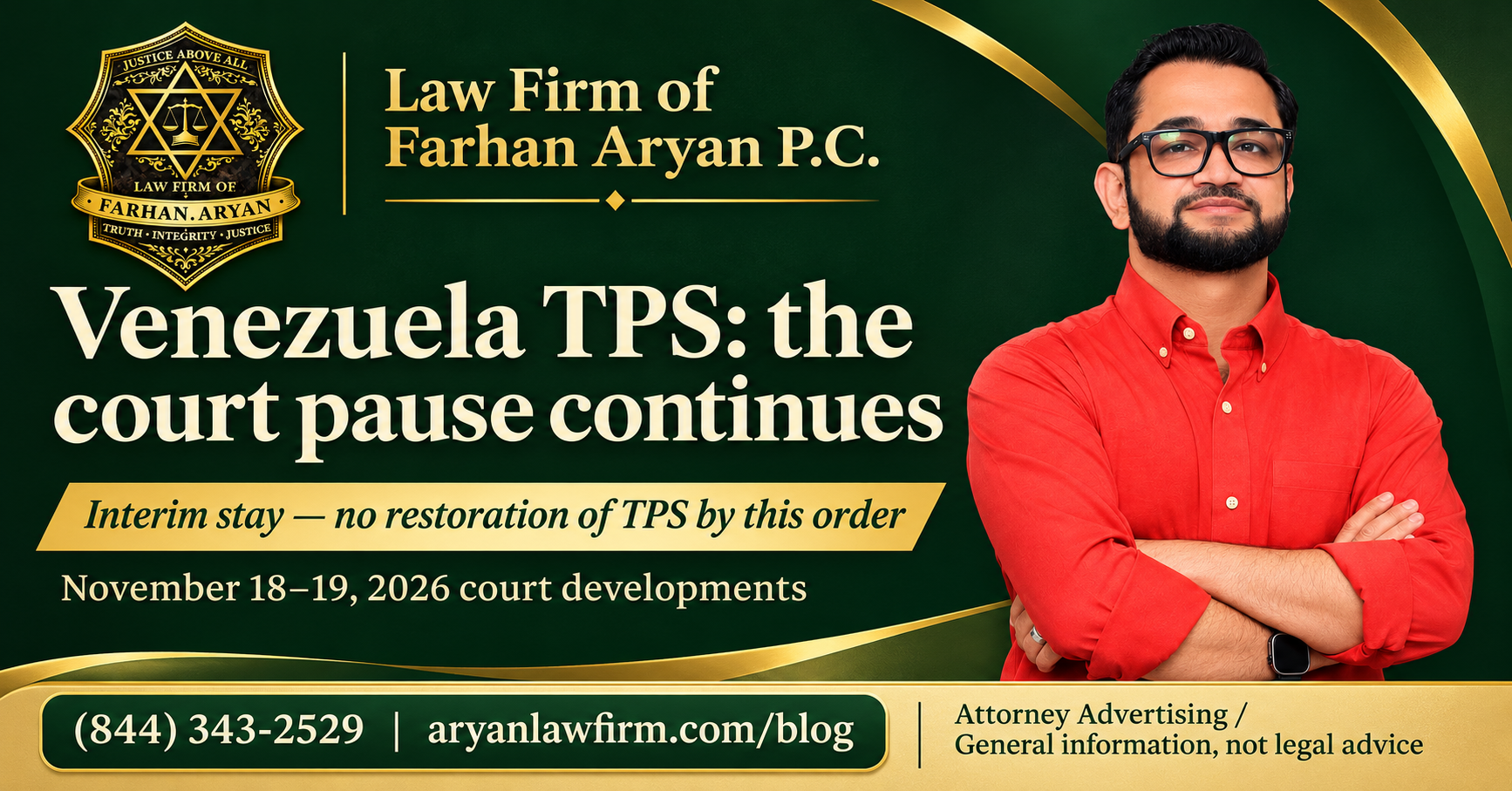
For Venezuelan families watching the calendar, November 20 had appeared to be an important endpoint. A new order changed that timetable. In National TPS Alliance v. Mullin, Nos. 25-5724 and 26-187, the Ninth Circuit granted an administrative stay on November 18, 2026, expiring seven days after publication of its judgment. The order gives no fixed calendar date for that event.
An administrative stay temporarily holds a court ruling in place or prevents it from taking effect while the court considers what comes next. Here, the pause concerns the district court judgment challenged by the government in the Venezuela TPS litigation. It is not a decision granting immigration benefits.
Why the Supreme Court withdrawal does not mean TPS was restored
The government had asked the Supreme Court for a stay on November 18. In its November 19 letter, the Solicitor General explained that the Ninth Circuit had since extended its administrative stay and withdrew the application. The Supreme Court docket records the withdrawal on November 19.
That distinction matters: withdrawing an application is a party's procedural step, not a Supreme Court judgment deciding that TPS must be restored. The government also said it intended to seek further Supreme Court relief if the Ninth Circuit entered an adverse judgment. That statement describes its litigation position, not an order the Supreme Court has issued.
Who should pay attention, including in New York
This development is relevant to Venezuelans whose circumstances depend on the TPS actions at issue in these appeals, including people living in New York. It should not be read as a change to every country's TPS designation, a new registration period, or an automatic extension of an employment authorization document.
The November 18 document is an interim order in particular litigation, not a published merits opinion establishing a general rule of immigration law. Its effect on the challenged judgment is different from a circuit precedent governing unrelated cases. It does not supply new controlling Second Circuit law for New York immigration proceedings.
Before making a work, travel or filing decision
Keep your TPS notices, work permit, renewal receipts and any removal-court documents together. Ask counsel to check the specific designation, notices and other immigration options that apply to you. These two court developments alone are not a basis to assume permission to work or travel.
Check for the appellate judgment and any later stay before relying on a date circulated online. A seven-day period tied to a future judgment can change again through another order. This article addresses the November 18 order and November 19 withdrawal; it does not promise what the courts will do next.
Discuss your circumstances
Law Firm of Farhan Aryan P.C. assists clients in understanding immigration options and case deadlines. Request a consultation at https://www.aryanlawfirm.com/#contact or call (844) 343-2529.
Attorney Advertising. General information, not legal advice. Reading this article does not create an attorney-client relationship. Individual eligibility and current court orders require separate review.
- Ninth Circuit: National TPS Alliance v. Mullin, Nos. 25-5724 and 26-187, Dkt. 109.1, November 18, 2026 — complete court-filed order via CourtListener
- Supreme Court: Solicitor General's November 19, 2026 withdrawal letter, Mullin v. National TPS Alliance, No. 26A714
- Supreme Court: official docket, No. 26A714, recording November 19 withdrawal
Source materials were consulted for this original article. Links lead to external resources; later changes may affect the information discussed here.
Attorney Advertising. General information as of November 20, 2026; not legal advice or a prediction of results. Eligibility and strategy require review of your individual circumstances. Read our Legal Disclaimer.