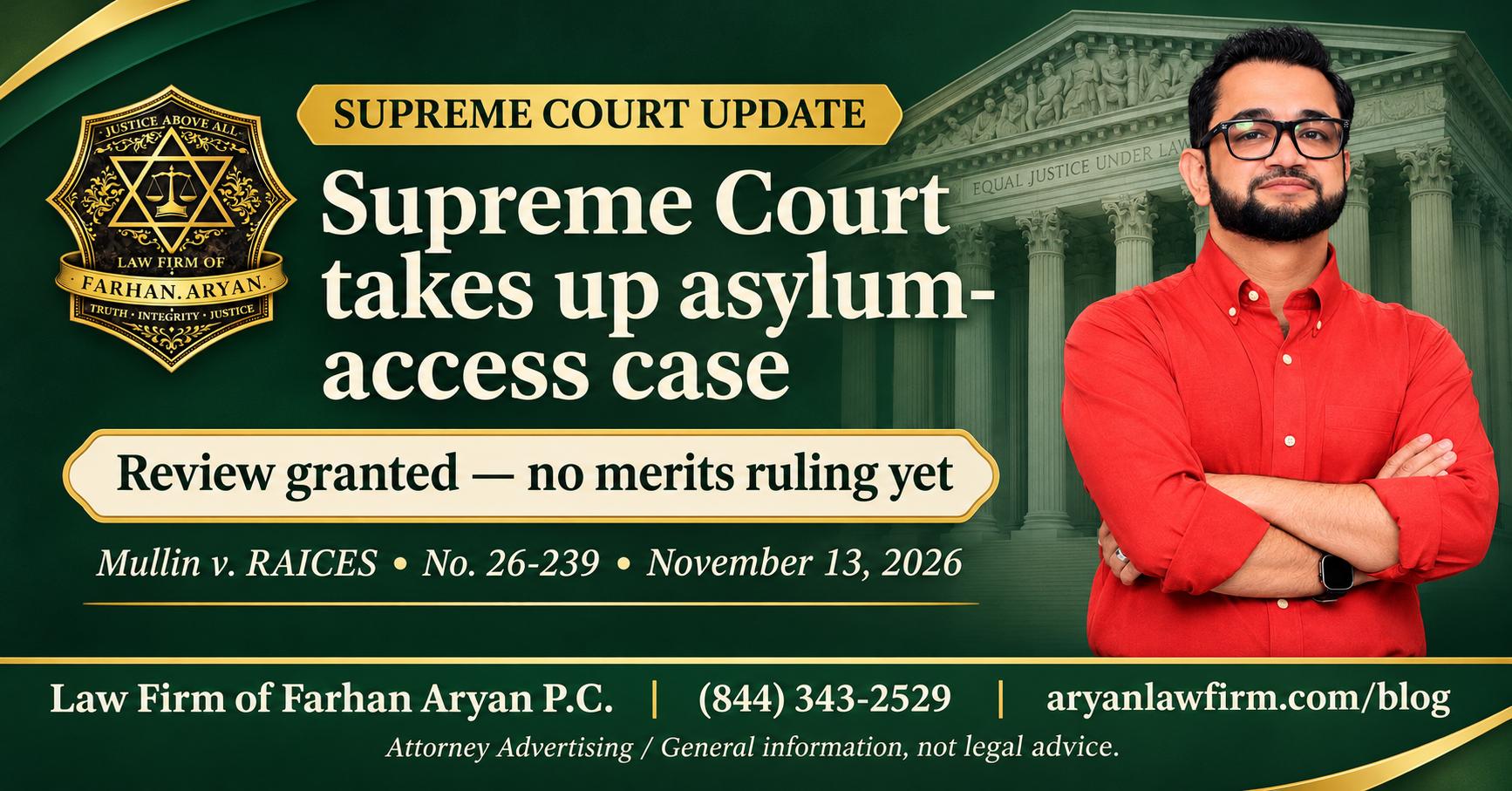
The Court granted review of two questions concerning Proclamation 10888 and classwide relief. It has not issued a merits ruling in this case.
What the Court did on November 13
The Supreme Court granted review in Mullin v. Refugee and Immigrant Center for Education and Legal Services, No. 26-239, limited to Questions 1 and 2 in the government’s petition. The official docket identifies the decision below as an April 24, 2026 D.C. Circuit ruling, with rehearing denied July 23.
This is a grant of certiorari: the Court has agreed to consider specified issues. The November 13 order contains no holding resolving them. It is not a new asylum eligibility rule, an approval of the proclamation, or a grant of asylum.
The two questions accepted for review
The first concerns whether Proclamation 10888 and its implementing guidance are lawful. The Court’s questions-presented document describes measures suspending entry of certain people and restricting access to statutory protections, including asylum.
The second asks whether 8 U.S.C. § 1252(f)(1) bars the classwide relief entered by the district court. The petition’s separate third question, concerning the class definition under Article III and Rule 23, was not included in the grant.
What this means for a pending matter
The litigation concerns federal measures with implications beyond one state, but the grant itself gives no individual permission to enter, remain or work. The November 13 order does not itself issue a stay or change an injunction. Separate lower-court and stay orders must be examined to determine what can be enforced in a particular situation.
This article addresses the newly granted review. It does not certify the current reach of every lower-court order or a person’s membership in a protected class. No later modifying Supreme Court entry was shown on the docket reviewed for publication. The materials reviewed did not establish an argument date or a deadline for the Court’s decision.
A practical next step for New York families
If you or a relative have a pending protection claim, start with the documents already governing that matter. Keep the application, hearing notices, prior decisions and any removal or custody paperwork together. Explain the entry history and procedural timeline to counsel before assuming that a national headline changes the case.
Our recommendation is to ask a focused question: which current order, if any, applies to this person, and what must be done before the next deadline? An agreement to hear a case is a reason to monitor it carefully. It is not a reason to miss a hearing, stop preparing evidence or make travel plans based on an expected result.
Bring the complete record to a consultation. Counsel can assess the rules and orders relevant to the matter while keeping future Supreme Court developments separate from obligations that already exist.
- Supreme Court: November 13, 2026 miscellaneous order — full order granting review
- Supreme Court: official docket, Mullin v. RAICES, No. 26-239
- Supreme Court: official questions presented and limits of the grant
Source materials were consulted for this original article. Links lead to external resources; later changes may affect the information discussed here.
Attorney Advertising. General information as of November 13, 2026; not legal advice or a prediction of results. Eligibility and strategy require review of your individual circumstances. Read our Legal Disclaimer.